Monday, September 14, 2009

Take the Fight to Glenn Beck!

If you haven't heard, Glenn Beck sucks. He successfully carried out a false smear campaign against Van Jones that forced Van to resign (the President helped by not standing up for Van). That campaign was based on racist attitudes towards African-Americans. He attacked Jones's past as a community organizer in California, equating black people organizing themselves with extremism and hating America (!). In a scary reversion to the days of McCarthy, Beck used red-baiting strategies, accusing Van and by extension Obama of being a communist (although anyone on the left will tell you that Obama is, if anything, a centrist). Anyone that has read about the persecution and witch trials of the 1950's should be concerned by this development.

We live in a free society. Glenn has the right to say what he will. However, from his position at Fox News he has a privileged position to have his speech heard. As a member of our news media, he has a responsibility to all of us to remain within a civilized discourse, refraining from racism and fear-mongering. His rhetoric damages our democracy by reducing the ability of people to speak across ideology. As consumers of the news, we have the right to assert our free speech rights and challenge his position of privilege.

Let's take the fight to Glenn! Click here and sign a Color of Change petition to companies to stop advertising during his show. More than 200,000 people have signed, and in response 62 companies have stopped advertising during the Glenn Beck show. Haha, let's get him to shed some tears, as the above picture demonstrates he is wont to do.

Sunday, September 13, 2009

What's really in these health care reform bills?

The Radical Right is fond of saying that the Democrats favor a "government takeover" of health care. Even if the Democrats were proposing a single-payer system, the Radical Right would be full of shit. A single-payer insurance system isn't a takeover of the health care system as a whole, just the insurance part of it. As far as I know, no one is proposing a British-style system where the government runs health care delivery as well as insuring all its citizens.

But the biggest inaccuracy in that statement is that the Democrats' main reform proposals do not come close to a single-payer system. These plans won't get rid of useless insurance companies that just take a piece of the action for their Wall Street investors on every health care transaction. Instead they would preserve the structure of the insurance system mostly as it is. Let's take a critical look at what is really in the Democrats' health care plans.

I'm going to base this mostly on the House bill, but the Senate bill that passed out of the HELP committee (that's Sen. Kennedy's committee) is pretty similar. These bills are huge and bring a lot of different changes in health care policy under one umbrella. Open Congress has a summary of HR 3200 here, the New York Times has a graphic comparing the various proposals here in regards to expanding insurance coverage here, and Ezra Klein has a good summary of the House bill here.

Note: The House bill has passed out of three committees in slightly varied form, but the basic outline is the same. The Senate will have another bill from the Finance Committee, headed by Sen. Max Baucus, that will be different than the HELP bill, and probably way less progressive because Baucus is negotiating with Republicans who probably won't vote for the final bill anyways. More on the Baucus bill later.

1) Covering the Un-Insured with Subsidies and Mandates

The plan uses mandates to get close to universal coverage. Under the employer mandate, also called the "pay or play" provision, employers must offer a group plan to their workers and pay the majority of its cost or else pay a tax, either on their payroll or per employee. Under the individual mandate, everyone who doesn't have employer-based coverage has to buy an insurance plan or else pay a penalty.

Another way the bill seeks to cover the un-insured is by expanding Medicaid. Medicaid pays for health care for families below the poverty line. It would increase the maximum income to qualify up to 133% of the poverty level, which would help a lot of the poor un-insured.

For the un-insured and small businesses that don't qualify for Medicaid or can't afford insurance, the plan creates a national "exchange" where they can shop for plans. All the plans have to offer a minimum of benefits, and can only make consumers pay a certain amount in deductibles and co-payments, preventing people from being under-insured in the exchange. The idea is that it forces insurance companies to compete and should lower their administrative costs because they don't need to market the plans as much. Even then people wouldn't be able to afford the plans (that's why most of the un-insured don't have coverage!), so subsidies are available for people with incomes up to 400% of the poverty level to buy insurance.

The House bill currently includes the "public option." This would be a government-run, non-profit insurance plan that people would pay their premiums to just like any other insurance plan. It should have lower premiums because of lower administrative costs and power to bargain with hospitals and pharmaceutical companies.

Anyone who gets coverage through their employer cannot leave that plan and buy insurance on the exchange. So a very limited amount of people could buy into the public option. Also, the public option wouldn't get special taxpayer subsidies. People buying insurance on the exchange would get the same subsidy whether they buy one of the private plans or the public plan.

2) Consumer Protections: Reduce Under-Insurance

The bill has consumer protections, mostly aimed at reducing under-insurance, which occurs when people have insurance but still get stuck with a large chunk of the bill (a majority of those who experience medical bankruptcy actually had insurance). It bans the insurance company practice of dropping people when they get sick because of a pre-existing condition that those people didn't inform them about. It also bans companies from not covering someone to begin with because they have a pre-existing condition. The bill prevents companies from discriminating in its premiums based on anything except age, geography, or family enrollment. Finally, it caps what families and individuals have to pay out-of-pocket under an insurance plan, which will greatly help reduce medical bankruptcy.

3) Medicare Reforms

This part of the bill could be another bill on its own (I wrote about how conservatives like David Brooks are falsely characterizing this section here). It expands coverage for most seniors in that it makes preventive care free and provides greater assistance for buying prescription drugs by closing the so-called "donut hole." It also staves off a reduction in payments to doctors that was planned earlier so that doctors won't stop taking Medicare patients.

Despite those increased benefits, the bill still extends the projected solvency of the Medicare trust fund from 2017 to 2022. The best things that it does is cut overpayments to private plans that cover elderly people through Medicare Part C, the Medicare Advantage plans. It also cuts the growth in payments to hospitals, and creates incentives for hospitals to ensure when they discharge a patient, the patient doesn't have to return soon thereafter, which costs Medicare a lot more.

4) Other

The bill funds the creation of an institute to do "comparative effectiveness" research. Basically it would seek to find which treatments for a given condition get the best outcomes for the least cost. These findings could be used eventually to cut costs in Medicare (or when we move to a single-payer system some day!).

Like with Medicare, it increases coverage for preventive care under Medicaid.

__________________________

So let's recap what's in the bill: consumer protections; mandates, an exchange, subsidies, and (hopefully) a public option to expand coverage; and Medicare reforms with some smaller items as well. The big question is: does it meet the goals of health care reform?

Does it get us to universal coverage? Pretty darn close but not quite. The Congressional Budget Office found that 3% of Americans will still go without coverage. 3% of Americans is still a lot of people. The consumer protections should do a lot to combat the problem of under-insurance, and the high rate of medical bankruptcy that it causes.

Does it cut costs? If so, not by much. The cost savings in Medicare are great, because treatment for the elderly is a big chunk of our health care system. But does it do anything to cut the costs that a private insurance market creates for us all? I'll get into that later, but the short answer is, nope. Near-universal coverage ideally should cut insurance premiums for everyone. Hospitals won't have to charge insurance companies as much to compensate for treating the un-insured. However given the profit motive, it's likely that insurance companies and perhaps hospitals will simply pocket the savings. The employer mandate and subsidies should bring down premiums for working families, but won't really cut overall costs, just transfer them to businesses and/or taxpayers.

Does it improve care? Yes, by expanding insurance coverage and improving coverage for preventive care under private plans, Medicare, and Medicaid, the lack of which was formerly a big reason why our health care outcomes are not as good as those of other countries.

One last question: Does it come anywhere close to reform on the level of single-payer? Not even close!
In the coming days, I'm going to keep blogging on parts of the plan that need to be improved and/or retained for it to be worth supporting, as well as on what parts single-payer advocates should be concerned about.

Saturday, September 12, 2009

Why Single-Payer Insurance Is the Best Solution for Our Health Care Woes


As I've documented earlier, the US has by far the most expensive health care system in the world, and we're basically the only developed country that does not guarantee access to health care. A big part of that is because of our terrible insurance system. Most Americans buy health insurance, either individually or as part of their employer's plan, from a number of private insurance companies. Although we are not the only developed country with a partially private health insurance sector, we have the system with the least public sector involvement and the least regulation, and the result is high economic and human costs.

The idea for years has been that competition forces companies to offer their products at lower prices. That's often true in some areas of our economy. Health insurance, however, is one sector in which the "invisible hand" of competition actually drives up costs. You don't have to be a socialist to see that, and to understand that we have to replace private insurance companies with a government-run "single-payer" plan to cut costs.

Under our current system, we pay premiums to health insurance companies, and in return they pay when we have to go to the doctor or to a hospital. In a single-payer system, the government acts as the sole payer for treatment, as the name implies. In return for citizens paying their taxes, the government guarantees health care access for everyone. It's way more efficient than a fragmented system of private insurers, and no one has to forego treatment because they don't have insurance.

Here's a couple reasons why single-payer insurance system would accomplish the three goals of health care reform I outlined back in August: universal coverage, lower health care costs, and improved health care outcomes.

1) Overhead and Profits

Private insurance companies have far higher administrative costs than single-payer systems, basically higher overhead. They need sales departments to add to their customer base, and huge marketing departments to bolster their image and attract more customers. Whereas single-payer systems get their premiums automatically through taxes, private plans have to have a billing department to make sure people pay. Because of the profit motive, they spend money to deny claims so they have to pay for less treatment, and they spend money to deny coverage to people who might cost them more to begin with ie. people with "pre-existing conditions." Finally, they pay massive salaries to their executives, which obviously doesn't happen in government agencies.

On average, overhead in the private industry ranges from 12-14%. In the small group market it's 25-27% and higher than 40% on the individual market (see here)! Meanwhile, the overhead for Medicare is somewhere below 3%, and the Canadian system has attained overhead below 1.5%.

Studies of insurance industry overhead generally don't include profits that go to shareholders, and they don't always include their spending on political contributions and lobbying. Jacob Hacker cites a study of profits of Medicare Advantage plans, a privatized portion of Medicare in which Medicare pays a private insurance company to cover a person. Those private plans spent 6.6% of premiums on profits! On the Bill Moyers Journal, former industry executive Wendell Potter explains how companies compete for Wall Street investment by paying the least amount of premium dollars on actual treatment that they can (here).

So between the motivation of profits and competition, private plans are far more inefficient than government-administered insurance plans. As Congressman Anthony Weiner is fond of saying, insurance companies basically take a piece of the action on every health care transaction, so who needs them? I'm sick and tired of liberals as well as conservatives defending the need to have a private health insurance industry. If the government can provide the same service for far less cost, than it should do so.

2) Administrative Costs Outside of the Insurance Industry

Overhead and profits aren't the only part of the story. A key study by Dr. Steffi Woolhander and Dr. David Himmelstein from Physicians for a National Health Care Plan found that 31% of our health care expenditures in total go to administrative costs, about twice that in Canada. They document how a private insurance system not only creates costs in overhead and profits, but creates costs on the health care delivery side as well because of its fragmented nature.

Because they have to handle payments from a number of different entities, hospitals, clinics, nursing homes, and doctors have to hire more clerical staff to deal with all the paperwork. On top of that, they spend a significant amount of time dealing with that paperwork themselves, time better spent treating patients. Furthermore, large employers have to hire clerical staff to deal with their insurance plans as well. Dr. Himmelstein finds that hospitals would save $120 billion in overhead and doctors would save $95 billion under a single-payer plan, which is well more than the $131 billion that would be saved from less overhead (see his testimony to Congress this spring here).

Dr. Himmelstein finds that a single-payer plan would save nearly $400 billion per year over our current system in lower administrative costs alone! Keep in mind that the mainstream Dems are looking for ways to cut the $1 trillion price tag of their reform plan over ten years. A single-payer plan would save our economy more than the entire cost of that 10 year plan in 3 years!

3) Negotiating Lower Prices

Because they take a piece of the action on each transaction, insurance companies don't have the incentive to negotiate lower prices with health care providers and pharmaceutical companies, nor do they have enough customers to have a lot of bargaining leverage. A single-payer plan obviously has the incentive because taxpayer dollars are at stake. Because a single-plan would cover so many people, it would have way more bargaining power. As a result, we would reduce overpayments to hospitals, doctors, and drug companies.

Here's a case in point. The Veterans Health Administration negotiates drug prices with pharmaceutical companies, and Medicare Part D does not. Consequently, the VA pays 49% less for the same drugs!

These savings can't be calculated in as straightforward a fashion as administrative savings, but they would certainly be huge.

4) Guaranteeing Health Care for All!

These savings would allow the government to pay for everyone's health care without co-payments and deductibles, according to Dr. Himmelstein and others. Because the government is accountable to the people, unlike insurance companies, nobody would be denied care or stuck with huge medical bills. Thus a single-payer plan would eliminate the problem of the un-insured and under-insured in one fell swoop.

Although single-payer is the only way to dramatically cut costs from our private insurance sector, it's not the only way to cover the un-insured and end under-insurance. For example, the Democrat's plan would cap what insurance companies can make consumers can pay out-of-pocket and require plans to have basic benefits to end under-insurance. It would ban denial based on pre-existing conditions and create subsidies to cover the un-insured.

However, the Congressional Budget Office found that 3% of Americans would still go without insurance under their best bill, HR 3200. 3% of Americans is no paltry sum. Single-payer is the only way to guarantee coverage for all. With universal coverage, we can save the lives of 18,000 Americans every year who otherwise would have died without insurance coverage.

__________________________

So there you have it folks. As I said earlier, we have to keep in mind the basic goals of reform: universal coverage, lowering costs for families and businesses, and improving our health. Single-payer is the way to go because it achieves all three goals. Any "reform" plan that maintains a mostly private insurance system will not be able to cut costs nearly as much, and probably won't truly guarantee coverage for all.

A nice thing about single-payer is that you can still have a private health care delivery system. Doctors and hospitals would still be private entities (private hospitals, some hospitals are already public). The only difference would be that government would be the sole payer for your treatment. So single-payer is far from socialized medicine, it's just socialized health insurance.

Another thing to note is that we already have government-run insurance programs: Medicare, Medicaid, the VA, and several others. Primarily because older people need more health care and they're covered by Medicare, our government already pays for 47% of health care in the US! And as some of the examples I cite above demonstrate, it does so far more efficiently than private insurance companies. Some critics say that moving to single-payer would be too much of a disruption because it would be starting a system from scratch. But it would actually consist of building on government-run programs we already have. That's why a lot of single-payer advocates refer to the system as "Medicare-For-All."

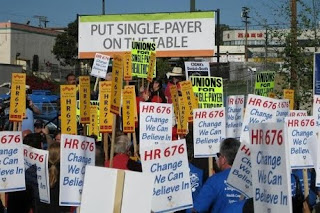
I'll talk more about the politics of single-payer later on. For now let me say that currently single-payer doesn't have the votes to pass in Congress. John Conyers' single-payer bill in the House, HR 676, has 85 co-sponsors, which is great, but not enough to pass because of opposition from Democrats that favor the regulate-and-subsidize approach. No matter what passes or doesn't pass this fall, single-payer has to be the long-term goal of American progressives. It's the only way we can insure everyone and hold down costs that threaten to swamp our middle class and restrain our economy as a whole.

Monday, September 7, 2009

The Resignation of Van Jones and the Obama Administration's Failure to Stand Up for Him


If you're not familiar with Van Jones, he's one of the leaders in the green jobs movement, and until Sunday briefly an official in the Obama administration. He is largely responsible for making "green jobs" and "clean energy jobs" part of our lexicon, and for demonstrating the positive economic effect of de-carbonizing our economy (in fact, investment in renewable energy and energy efficiency yields significantly more jobs than the same investment in fossil fuels). His influence on the environmental movement and the Democrats' climate policies has been enormous, to a large degree because he's a fantastic orator. As an African-American, he's brought a lot of black and Latino people into a previously mostly white movement, and consequently provided the movement with a broader perspective. He's been an advocate for low-income people and minorities, not only in terms of protecting them from the pollution they disproportionately face, but in ensuring that green jobs can be a means to economic justice for them.

On Sunday, he resigned from his post in the Obama White House in the face of a campaign by Glenn Beck at Fox News and other far right-wingers who questioned some aspects of his past (see NY Times article here). The campaign was disgustingly based in falsehood and extreme distortion of fact.

I was going to write a long piece on how mad I am that Glenn Beck's crazed far-right campaign against him succeeded. The campaign had many racist aspects to it, which Carl Pope of the Sierra Club summarizes on his blog here. What really pisses me off, though, is that the Obama administration refused to stand up for Van Jones. Why should they heed the calls of an extreme right-winger like Beck who has a large but narrow following of people who wouldn't ever vote for a Democrat anyways? John Nichols of The Nation puts it best here.

Although this controversy may have been a distraction from the health care and clean energy debates, it wasn't a big one. It would have been easy for administration officials to simply rebut Beck's falsehoods and move on. The effects of caving to Beck's crowd is far worse. First of all, it will only embolden the racist reactionaries to continue smearing progressives in the administration and Congress for that matter. Secondly, it shows major weakness on Obama's part. Do you ever remember any liberal media blocking an appointment in the Bush administration that didn't require Senate approval? This makes them look REALLY weak going into these huge legislative battles, primarily within their own party. If anything letting Jones resign without a fight makes victory on health care and climate legislation less likely.

Sunday, September 6, 2009

Great American of the Week--Rep. Anthony Weiner (D-NY)

Rep. Anthony Weiner from New York has been the most visible and effective advocate for truly progressive health care reform over the past months. He's been all over TV talk shows advocating for a single-payer system. Given his preference for single-payer, it would be easy for him to sit back and just criticize the more incremental plans that the President and centrist Dems support. But, like good legislators do, he's fighting in the media and in the trenches to make sure that that plan does all it can to move towards the three basic goals I listed in my first blog post: universal coverage, cutting costs, and improving care. For that reason, he's been one of the leading progressive threatening to hold up reform if it does not include the public option. He's also convinced Speaker Pelosi to allow a floor vote on his amendment to replace the current health care bill, HR 3200, with Rep. Conyers's HR 676, which would create a single-payer system (see summary here).

He's so effective in his TV appearances because he makes health care policy clear. Even someone concerned about government's role in the economy can listen to his clear argument and see that single-payer is the best system for our economy. In my post below, I agreed with Bill Moyers that we have to frame health care reform as a moral issue. It might seem contradictory to laud Rep. Weiner for how he describes cutting costs, a less visceral theme. But Weiner succeeds where Obama fails in describing the importance of cutting health care costs because he frames it in a moral way. It's us versus the insurance companies. They take money from us on each transaction between us and the doctor.

Finally, he's so quick on his feet and quite aggressive. Unlike most Democrats, he's afraid to challenge right-wingers directly and put them on the defensive.

Check him out destroying the Fox and Friends conservative crowd.
The man is quick on his feet. Check him out on the show of Joe Scarborough, another prominent conservative host. He makes Scarborough speechless. I love his explanation for how Medicare-for-All or a large public option can not only cut costs through low overhead and not having to pay shareholders, but through negotiating with drug companies and care providers as a large pool of people. How does Wal-Mart offer such low prescription drug prices? Brilliant.
For being such a champion of single-payer, and standing up for the public option as the only acceptable compromise to take on the insurance companies, Rep. Weiner earns the title of Great American of the Week from yours truly. Haha, like he gives a shit, but whatever.

Bill Moyers on the Bill Maher Show

Bill Moyers appeared on the Bill Maher Show on August 28. As you can see from my post on a documentary that appeared on his show, I'm a big fan of Bill Moyers, and I think he's one of the clearest and most principled thinkers in the American left (my girlfriend thinks I have a man crush on him, haha). This appearance shows Moyers at his best, touching on health care, government and social justice, money in politics, and his past in the Kennedy and Johnson administrations. You should go ahead and watch all 3 parts of the interview on Youtube, but I'd like to list some of his best points.


Moyers believes that true reform in health care and other areas is limited by the pervasive influence of corporations in both parties. He traces this back to the Buckley v. Valeo Supreme Court decision in 1976, which ruled that spending money is a form of free speech. As a result, both parties, not just the Republicans, answer to corporate influence more than to average citizens. Moyers thinks that the problem is the Democrats even more than Republicans. The Republicans have stood for monied interests for some time, but Democrats used to stand for working people and the middle class. In 2006 and 2008 they were elected on promises of progressive reforms, but because they are influenced by corporate interests, they deliver only tepid reforms that pose little threat to the status quo. Bill identifies White House Chief of Staff Rahm Emanuel as the paragon of that particular type of Democrat. He and several other commentators have suggested that Rahm actually wants to water down health care reform, clean energy legislation, and financial regulation to ensure that affected corporate interests continue to donate to Democrats for the 2010 election cycle.

In the interview Moyers frames health care in a most excellent way. He states that our country is the only one that doesn't view universal health care as a means of social justice. I couldn't agree with him more that access to health care is a moral issue, and needs to be portrayed that way to achieve universal coverage. Maher asks him what he thinks would be a metaphor for our society than "a rising tide lifts all boats." Moyers responds, "we're all in the same boat." I've never heard anyone summarize progressive values that succinctly. The fact that 18,000 Americans die each from lack of health insurance is a moral failing of our society at large.

The last theme of this interview that really blew me away was his discussion of presidential leadership styles. He praises the tenacity of the Democrats in their battle to enact Medicare. President Truman first proposed the idea in the early 50's, and was shot down, but because he was so framed the policy it such a principled way, he set up LBJ to finally pass it in the 60's. He wants Obama to be a Teddy Roosevelt, who railed against corporate influence in politics, rather than a Grover Cleveland, a President elected to bring the robber barons under control and instead acceded to them. Unlike those who say the Democrats should take what they can get on health care, Moyers would rather see Obama go down fighting that pass a half-assed bill that doesn't bring health care industry under control. In that sense he could be a Truman to a later President's LBJ (ideally pushing Medicare-For-All!).

He unifies all these concepts in calling for a movement of progressives to not just push for reforms but directly challenge the President. I agree. Progressives need to stop seeing their work as "supporting President Obama's agenda" and start seeing it as "pushing Obama and the Democrats to stand up for ordinary Americans and confront monied interests."

Side note: The Progressive Change Campaign is starting to do just that. They are one of the few groups directly challenge Obama to stick to his campaign promise to include a government-run public option to compete with insurance companies (because requiring people to get insurance without a public option will be expensive for consumers and the government and basically constitute corporate welfare for the insurance industry). Sign their petition to the President here, and let's start demanding that the President be more progressive!

Friday, September 4, 2009

US Contractors Paying off Taliban!

Over the past decade our military has increasingly employed civilian contractors to carry out duties once performed exclusively by the military in combat zones. As the history of privatized military operations in Iraq demonstrates, this often results in shoddily constructed buildings, inadequate and unsafe services to soldiers, and egregious waste of taxpayer dollars. On top of that, the actions of unaccountable contractors can hurt the efforts of US soldiers. Remember when Iraqis were in an uproar after Blackwater mercenaries slaughtered 17 innocent civilians? Obviously not good for the mission there.

So far the worst effects of contracting out to private companies have occurred in Iraq, and their presence in Afghanistan so far hasn't been as big of a story. Because President Obama promised to crack down on the abuses of contractors, I think a lot of people assumed they wouldn't be used as much and would be less of a problem. Wrong. The Wall Street Journal of all places reported that the number of contractors in Afghanistan has been rising recently. Contractors now outnumber our soldiers there, despite the surge in troop numbers implemented by Obama.

Recent Pentagon plans will continue this phenomenon. The LA Times wrote a few days ago that the military will likely swap out 14,000 troops in Afghanistan involved in support duties for 14,000 combat troops, and will hire contractors to replace the support troops. This is intended to increase the amount of combat soldiers in Afghanistan without an overall troop increase that would be highly controversial back at home. Based on previous contractor experience, we can expect the cost of the war to rise as a result, with a lower quality of services to our troops. Also, we can expect more of the worst kind of contractor--mercenaries like those of Blackwater, because those support troops include "guards" according to the article.

Considering Obama's campaign rhetoric with respect to military contracting, these decisions are highly disappointing. They will flush taxpayer money down the toilet and hurt the war effort through providing poor services to our troops and through their lack of discipline and accountability. A recent story shows the depth to which they can do such damage.

CBS News picked up a story 2 days ago from the GlobalPost (CBS story here, GlobalPost story here) about reconstruction contractors hired by the US paying as much as 20% of their revenue to the Taliban to not attack their projects. Yes, you read that correctly, US taxpayer dollars have been funneled to our enemy through contractors. Granted, these are reconstruction contractors and not military contractors, but it demonstrates the same problem of employing a private company in a war zone that does not answer directly to the US government. And, who knows, maybe companies guarding our diplomats and bases or providing services to our troops have done the same.

It seems increasingly unlikely that President Obama will crack down on war contractors. Congress must fill his void of leadership and either reduce the usage of contractors, or, at minimum, create regulations to make them fully accountable for their actions and the quality of their work. It might make for an interesting coalition of anti-war progressives from the left, deficit hawks in the center, and libertarians on the right.

Addendum: The best source for information on war contractors is the great investigative journalist Jeremy Scahill. He wrote Blackwater: The Rise of the World's Most Powerful Mercenary Army, an excellent book and devastating critique of military contracting and American foreign policy. You can check out everything he writes on his blog/news site http://rebelreports.com/. He appears frequently on Bill Maher, Democracy Now!, and some of the MSNBC shows pretty frequently, and usually posts the videos there.